![Performance Review Examples: 50+ Templates for Every Rating and Role [2026] - Resource about Performance Reviews](/images/blog/performance-review-with-examples-full.webp)
What Is a Performance Review?
A performance review, also called a performance evaluation or appraisal, is a structured conversation and written record in which a manager and employee assess achievements, behaviors, and growth opportunities. Employee self-evaluations form a key part of this process over a defined period. When supported by modern employee review systems like Confirm, the process combines quantitative metrics with qualitative insights including 360-degree feedback and peer input to create an actionable development roadmap rather than a dreaded annual ritual. See how Confirm handles performance reviews.
Key idea: A performance review is not a judgment day, it is an iterative checkpoint that agrees expectations, recognizes wins, and charts future success.
Why Performance Reviews Matter in Today’s Workplace
- Aligning Strategy & Execution – Regular reviews using structured questions connect day‑to‑day work with company‑wide objectives, reducing misfit that costs mid‑market firms up to 23 % of productivity.
- Driving Engagement (supported by continuous feedback between formal reviews) – Employees who receive meaningful feedback are 3× more likely to be highly engaged (Gallup).
- Career Development & Retention – Coaching-focused growth plans lower regrettable attrition, especially for top hidden talent that ONA tends to reveal.
- Legal & Fairness Protections – Documented evaluations demonstrate consistent treatment, mitigating claims of bias or discrimination.
- Data‑Informed Decisions – When reviews are integrated with an employee review system (e.g., Confirm’s Workday connector), promotion and compensation calls become evidence‑based instead of gut‑feel.
What Are Common Goals for Performance Reviews?
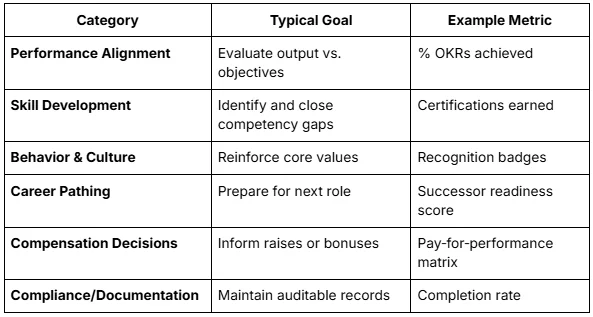
Key Elements of an Effective Performance Evaluation
1. Set the Right Tone
Open with appreciation and curiosity, psychological safety builds honest dialogue.
2. Recap Expectations and Goals
Review the original OKRs or goals set at the beginning of the cycle. This anchors the conversation in agreed‑upon criteria.
3. Share Performance Feedback
Provide balanced, evidence‑based feedback. Use the SBI model (Situation, Behavior, Impact) rather than vague statements.
4. Invite Their Perspective
Encourage self‑assessment first; employees often surface context (resource constraints, cross‑team dependencies) unknown to managers.
5. Discuss Development and Career Goals
Link feedback to growth opportunities: stretch assignments, mentorship, or learning paths inside your Learning Management System.
6. Set Clear Next Steps
Translate discussion into SMART goals with interim checkpoints. Confirm’s one‑click review workflow assigns tasks automatically.
7. End on a Positive Note
Summarize strengths, express confidence, and reiterate support, leaving employees motivated, not deflated.
How 360‑Degree Feedback improves Performance Reviews
Traditional top‑down reviews risk bias and blind spots. 360‑degree feedback adds input from peers, direct reports, and cross‑functional partners, yielding a fuller view of both results and behaviors:
- Reduces Bias: Aggregating diverse viewpoints dilutes individual bias.
- Notes Collaboration: ONA maps reveal influence and collaboration patterns invisible to hierarchical org charts.
- Supports Leadership Development: Leaders see how their style affects different stakeholder groups.
- Boosts Credibility: Employees perceive reviews as fairer when multiple voices are heard.
Pro tip: Use anonymized 360 feedback summaries to protect candor while spotlighting consistent themes.
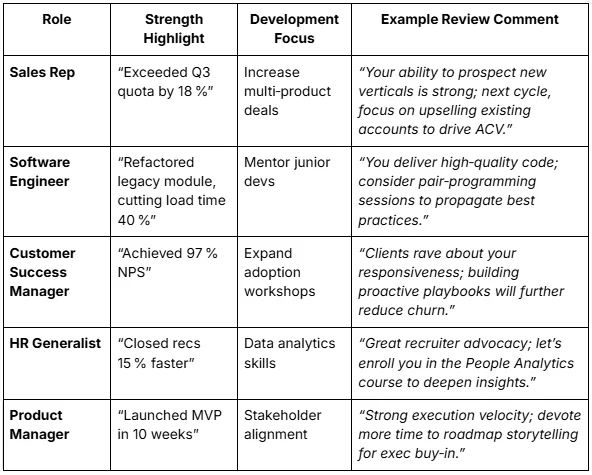
Performance Review Examples for Different Roles
Performance Reviews Best Practices
- Frequency Over Formality – Shift from once‑a‑year to quarterly or continuous feedback cycles.
- Calibration Sessions – Gather managers to normalize ratings and mitigate “manager‑leniency drift.”
- Evidence, Not Opinions – Pair anecdotal examples with data (metrics, 360 feedback).
- Bias Checks – Review gender, tenure, and ethnicity ratings patterns before finalizing.
- Link to Pay Transparently – Explain how ratings influence merit increases.
- Leverage Technology – Use an employee review system that automates reminders, pulls performance data, and generates AI‑assisted summaries.
- Train Managers – Provide scripts and coaching guides; confident managers give clearer, fairer feedback.
- Remote‑Friendly Adjustments – For distributed teams, gather asynchronous feedback, then host video‑based discussions to accommodate time zones.
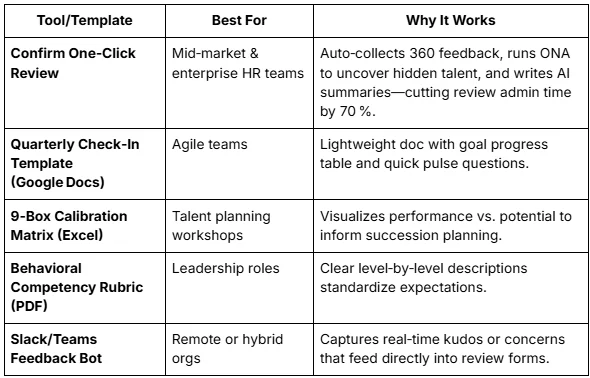
Tools and Templates to Simplify Your Review Process
Making Reviews a Strategic Advantage
When executed thoughtfully, performance reviews transform from a compliance checkbox into a strategic lever that fuels engagement, growth, and competitive advantage. By anchoring conversations in data, inviting multi‑rater perspectives, and equipping managers with intuitive tools, HR teams can shift the narrative from “dreaded annual appraisal” to “continuous career accelerator.” Platforms like Confirm, powered by Organizational Network Analysis and AI, make that evolution possible but painless.
Elevate your review process. Uncover hidden stars. Drive equitable growth. Let Confirm show you how.
- Use specific evidence, not adjectives: 'Delivered project 2 weeks early' beats 'Is a hard worker.'
- Calibrate ratings across the team: uncalibrated reviews systematically disadvantage underrepresented groups.
- Include 360 peer feedback: manager ratings alone capture only one perspective on performance.
- Connect reviews to development plans: without next steps, reviews are retrospective only.
- Review quarterly, not merely annually: annual-only reviews create recency bias and miss opportunities for early correction.
- Separate performance and compensation conversations: mixing them causes employees to negotiate rather than reflect honestly.
Frequently Asked Questions
What is the main goal of a performance review?
To agree employee performance and behaviors with organizational objectives while supporting development.
How do you write a performance review example?
Use concrete achievements, quantify impact, reference competencies, and propose actionable next steps.
What should be included in an employee evaluation?
Goal attainment, observable behaviors, 360‑degree feedback, development needs, and agreed‑upon objectives.
How is 360‑degree feedback used in performance reviews?
It supplements manager assessments with peer, subordinate, and partner insights, offering a holistic view and mitigating bias.
How can managers prepare for a performance review meeting?
Gather data early, script key points, anticipate employee questions, and schedule uninterrupted time.
What are the best practices for remote employee evaluations?
Leverage asynchronous feedback tools, schedule video reviews across time zones, and focus on outcomes rather than visible effort.
360-Degree Performance Review Examples by Relationship Type
360 reviews require different language depending on who's giving feedback. Here are real examples for each direction:
Upward Feedback (Direct Report → Manager)
- "[Manager] gives clear direction on priorities and is available when I need guidance. I'd appreciate more proactive communication about changes that affect my work."
- "Strong at advocating for the team to leadership. There are opportunities to create more space for different perspectives in team discussions."
Peer Feedback (Colleague → Colleague)
- "[Name] is my go-to for cross-functional projects — consistently reliable and solutions-focused. Communication across time zones could be more async-friendly."
- "[Name] brings strong technical depth and is generous in sharing knowledge. Would benefit from more proactive stakeholder updates on long-running projects."
Self-Evaluation Sample Answers
- "I exceeded my Q1 targets by 18% and mentored two junior team members through onboarding. My development area this quarter is becoming more comfortable presenting to senior leadership."
Learn how 360 feedback works in practice, and how Confirm automates collection, aggregation, and analysis.
Want to see how Confirm handles this? Request a demo — we'll walk you through the platform in 30 minutes.