Calibration software built on what employees actually do.
Most calibration software organizes the process. Confirm fixes it. ONA data replaces manager memory. AI profiles replace blank spreadsheets. Bias detection replaces gut-driven debates. Your team finishes calibration in hours, with ratings they can defend.

Your calibration software shouldn't make the process harder to trust.
Most calibration tools are digital rating forms. They make it easier to collect scores. They do nothing about the actual problem: the scores aren't trustworthy in the first place.
The typical calibration session runs like this. A manager walks in with a strong opinion about two or three people on their team. They don't have much to say about the others. The session fills up with advocacy and counter-advocacy while the quiet performers (the ones actually holding things together across teams) get reviewed in 45 seconds. The final distribution reflects whoever argued most confidently, not who contributed most.
Technology that digitizes this process is still technology built on a broken foundation.
The fix isn't a better form. It's better evidence. When every calibration discussion starts from ONA data (who this employee actually worked with, what cross-functional impact they drove, where the network depends on them) the session becomes fact-based instead of argument-based. Managers still discuss. The difference is they're discussing what the evidence shows, not what they remember or prefer.
That's what Confirm is: calibration software that brings the evidence layer that every calibration session needs but almost none have.
Every employee walks into calibration with a full evidence profile.
Before the session starts, Confirm generates a calibration profile for every employee from ONA data, performance history, and AI synthesis. Managers see who each person collaborated with, where they drove cross-functional impact, and how their network position changed over the review period. No one gets rated from memory alone.
ONA-powered collaboration data
Active ONA surveys surface who employees actually work with, who drives impact across teams, and where contribution happens outside a manager's direct line of sight. Calibration software that ignores this is working with incomplete information.
AI profile generation before the session
GPT-4 synthesizes months of ONA signals, review history, and manager notes into a concise calibration summary for every employee. Managers arrive at the session informed, not improvising.
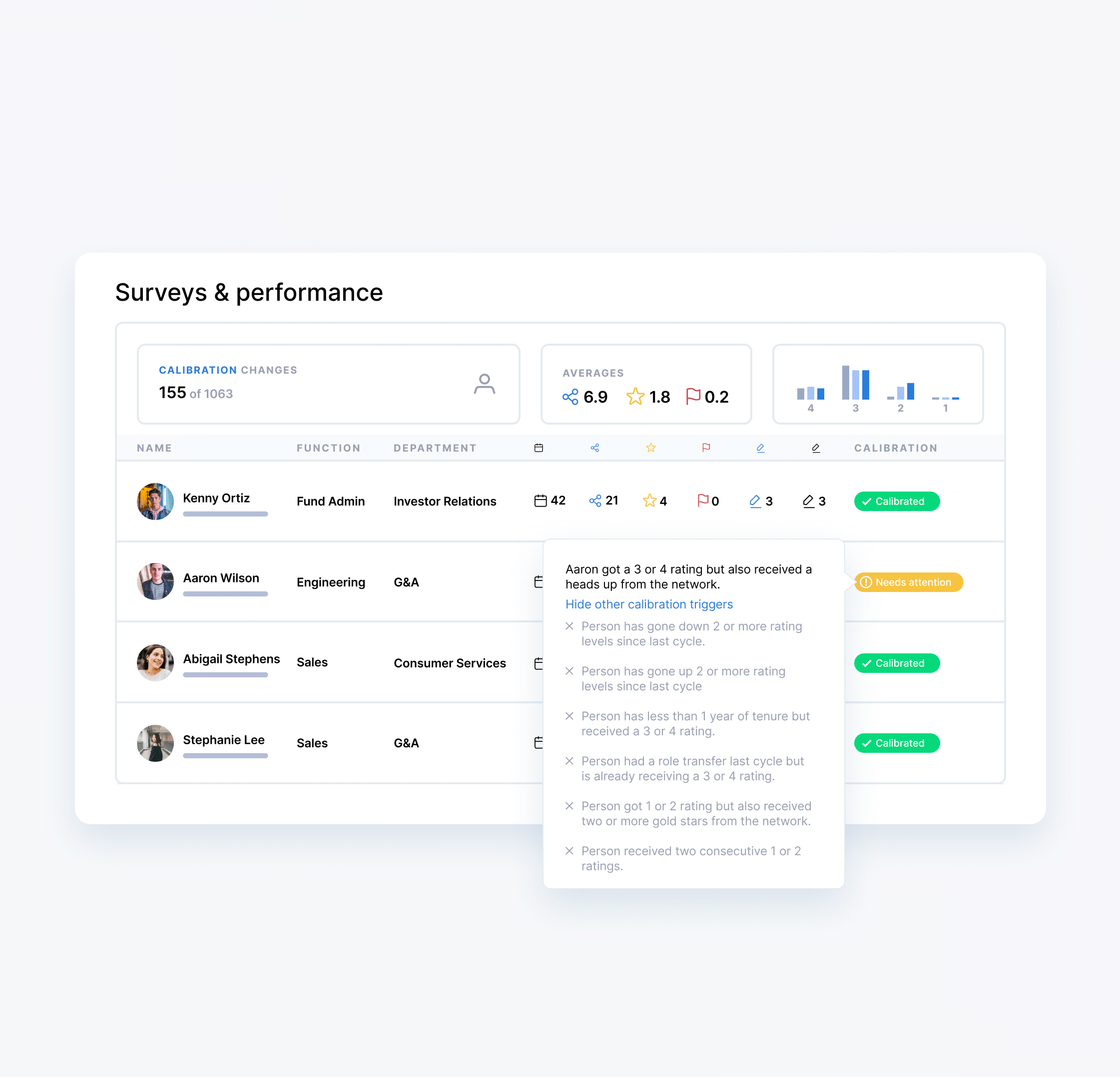
Bias detection that runs while your session is live.
The three patterns that most often corrupt calibration ratings: recency bias, affinity bias, and advocacy bias. They are hard to catch in the moment. Confirm monitors calibration discussions for these patterns and surfaces ONA evidence when a conversation starts drifting away from the data. After the session, a demographic disparity check flags unexpected patterns before decisions are locked.
Real-time bias flags
When discussion patterns suggest recency, affinity, or advocacy bias is driving a rating rather than performance evidence, Confirm surfaces the relevant ONA data to recenter the conversation.
Demographic disparity analysis
After calibration, Confirm runs a distribution check across gender, ethnicity, location, and tenure. If the data shows unexpected patterns, you catch them before they become comp decisions.
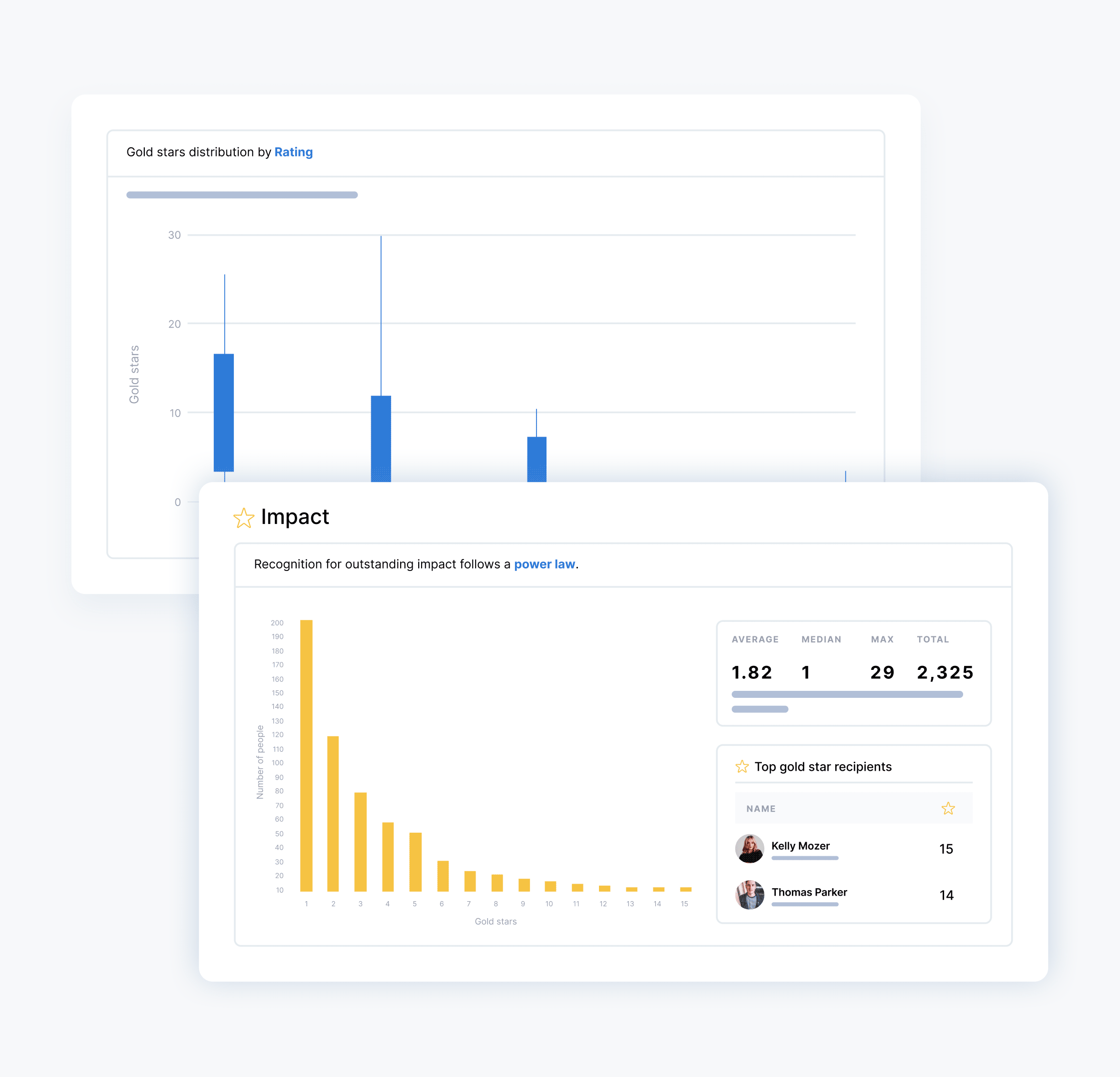
One session instead of three weeks.
A standard calibration cycle: pre-work preparation, a first session, a second session to handle disagreements, a third round of revisions, and then someone finally locks the spreadsheet. Confirm compresses this because the preparation work happens automatically throughout the review period. ONA data collects continuously. Profiles generate before the session. Bias checks happen in real time. Most teams complete calibration in a single 2-4 hour session.
Session-ready without manual prep work
Because ONA runs continuously and AI profiles generate automatically, there's no pre-work for managers to complete before calibration. The software does the preparation. Managers show up and make decisions.
Audit trail with rationale
Every calibration decision is recorded with the evidence behind it. You get a legally defensible record of your process: ratings, rationale, and the data used to reach each decision.
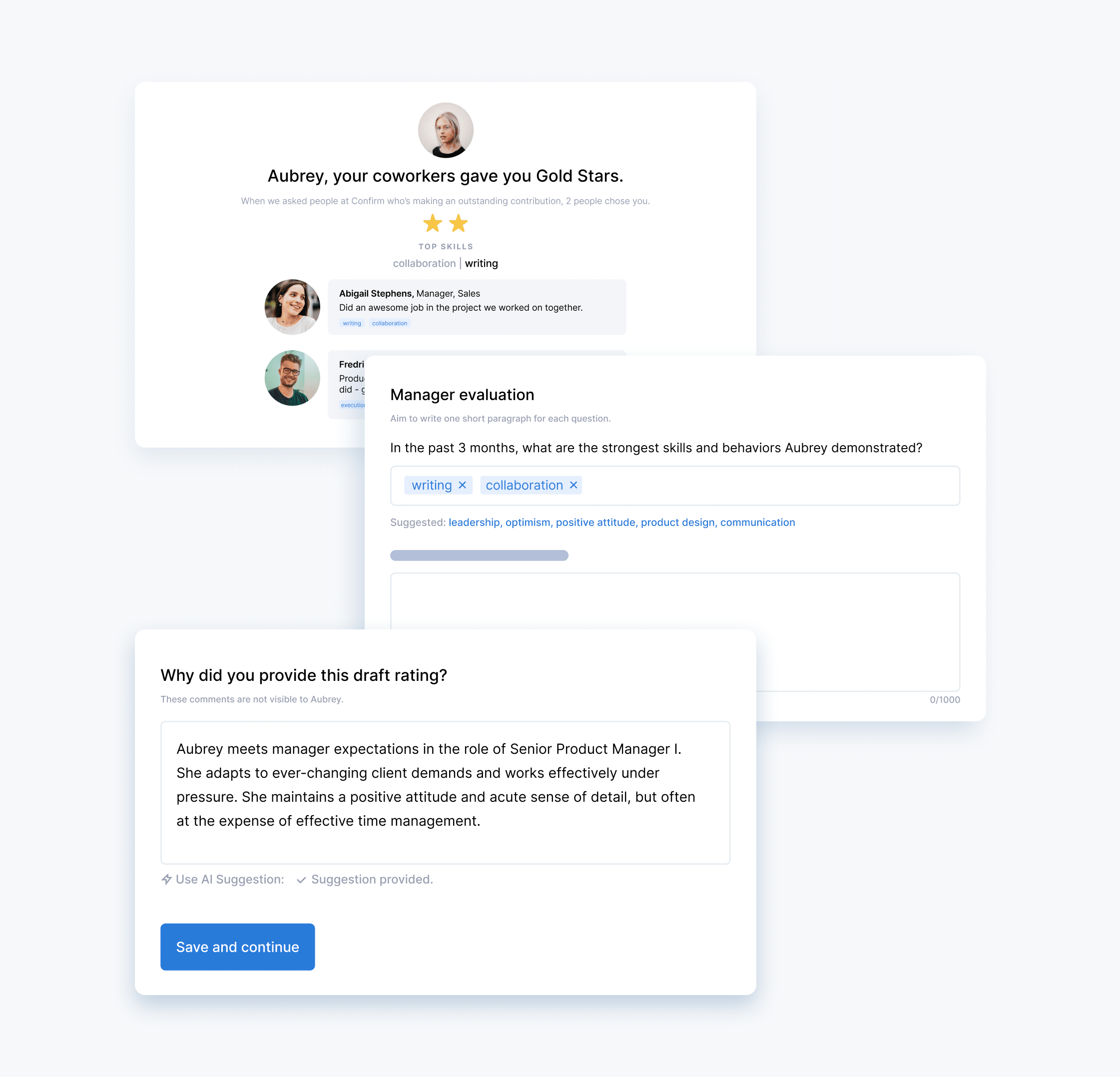
From calibration to comp
Calibration software that connects to comp decisions you can actually explain.
Most companies have improved how they collect feedback. 360s, continuous check-ins, structured reviews. But when comp season arrives, the decision-making falls back to manager instinct and whoever argues hardest in calibration.
Confirm's calibration software is the layer between feedback collection and defensible comp decisions. ONA data shows who drove real organizational impact. AI profiles give every manager the same evidence base. Bias detection flags problems before they compound into inequitable outcomes.
The result: raises and promotions tied to what employees actually did, with a process your team can stand behind when employees ask why.
See Confirm in action →
"[Confirm finds] which workers are vital to the flow of information."

"An effective way of reducing bias and creating an even playing field."

"[Confirm] creates a fairer playing field by expanding leaders' visibility."
Explore the whole platform
Performance Reviews
Modern performance management powered by ONA and AI.
Explore this feature ›Engagement Surveys
Turn employee feedback into action, faster.
Explore this feature ›OKRs and Goals
Track OKRs and career goals in one place.
Explore this feature ›Talent Management
Make better talent decisions, without the bias.
Explore this feature ›Feedback and Growth
Empower continuous feedback and development.
Explore this feature ›Get the Calibration Playbook
A practical guide to running calibration sessions that actually work, from structuring the agenda to handling the managers who won't let go of their ratings.
- Why most calibration processes produce the opposite of what they're supposed to
- How to structure an evidence-based calibration session from the ground up
- Techniques for surfacing hidden contributors who cross-functional managers miss
- How to challenge ratings constructively without triggering defensiveness
- The demographic disparity check every HR team should run after calibration
- What a legally defensible calibration audit trail actually looks like
Free PDF Download · Gated Access · Instant Download
Playbook
Proven strategies
See Confirm in action
See why forward-thinking enterprises use Confirm to make fairer, faster talent decisions and build high-performing teams.