
What Is a Performance Improvement Plan (PIP)?
A performance improvement plan (PIP) is a formal, time‑bound document that outlines specific performance gaps, measurable goals, resources, and checkpoints to help an under‑performing employee reach clearly defined standards. Unlike a verbal warning, a PIP is collaborative and data‑driven, turning subjective concerns into objective, actionable steps, especially when powered by Organizational Network Analysis (ONA) and AI‑assisted insights from platforms like Confirm. See how Confirm handles performance management.
When Should You Use a Performance Improvement Plan?
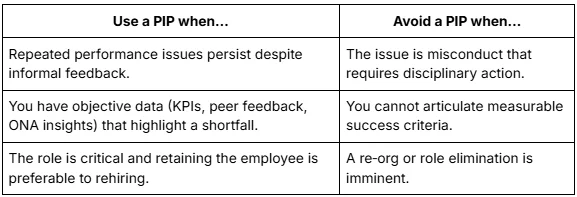
Remember, timing matters: start a PIP early enough that the employee still has the bandwidth, and goodwill, to improve but late enough that you can point to clear evidence.
Benefits of a Well‑Structured PIP Plan
- Clarity & Alignment – Translates vague dissatisfaction into concrete, SMART goals.
- Reduced Bias – Using network‑wide data (e.g., ONA) minimizes manager subjectivity.
- Higher Retention – Employees who “turn the corner” through a PIP often become top contributors.
- Legal Protection – Documentation demonstrates fair treatment and due process.
- Manager Capability Building – Forces consistent coaching and check‑ins, elevating leadership habits.
Key Components of an Employee Performance Improvement Plan
- Issue Statement – A concise description of gaps (quality, productivity, behaviors).
- SMART Goals – Specific, Measurable, Achievable, Relevant, Time‑bound targets.
- Timeline & Checkpoints – Milestone dates for reviews and feedback loops.
- Resources & Support – Training, mentorship, and tools the company will provide.
- Consequences & Outcomes – Clear articulation of what success and failure mean.
- Sign‑Off & Documentation – Mutual acknowledgment by employee, manager, and HR.
Step‑by‑Step Process to Create a PIP Plan
1. Evaluate the Situation
Pull quantitative data (KPIs, peer reviews, ONA maps) and qualitative observations. Confirm that performance, not role clarity or workload, is the root issue.
2. Gain Insights into Their Performance
Interview peers and stakeholders, analyze Confirm’s “hidden‑talent” graphs, and identify systemic blockers vs. individual gaps.
3. Hold Manager Reviews
Managers draft preliminary goals and desired outcomes, validating them with HR.
4. Get Started with a PIP Template
Leverage the downloadable template below or import Confirm’s one‑click PIP builder.
5. Have HR Review
HR ensures language is unbiased, goals are realistic, and legal boxes are checked.
6. PIP Meeting
Manager and HR present the plan, stress collaborative intent, and secure verbal fit before signatures.
7. Employee Check‑Ins
Weekly or bi‑weekly 15‑minute stand‑ups track progress. Confirm auto‑summarizes feedback, reducing admin load.
8. Plan Completion and Next Steps
Deliver a formal review on the end date, deciding on continuation, role adjustment, or separation.
What Should a Performance Improvement Plan Include?
Clear Identification of Issues
“Missed Q2 sales quota by 25%” is actionable; “bad attitude” is not.
SMART Goals
Example: “Increase demo‑to‑close rate from 15 % to 22 % by October 31.”
Defined Timeline Including Dates for Check‑Ins
Standard PIPs last 30–90 days, with midpoint reviews every 2 weeks.
Resources and Support
Training budget, shadowing top performers, product‑knowledge refreshers.
Consequences of Outcomes
- Successful completion: remain in role; eligibility for bonus reinstated.
- Partial progress: extend PIP 30 days.
- No progress: initiate termination (see: how to fire an employee the right way).
Documentation
Store all notes in a centralized system (Confirm integrates with Workday & BambooHR for a single source of truth).
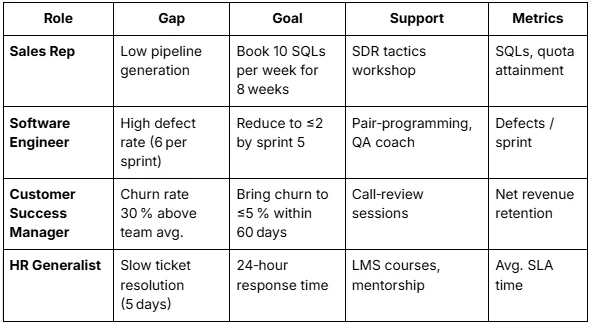
Performance Improvement Plan Example for Different Roles
Performance Improvement Plan Templates You Can Use
- Simple 30‑Day PIP (Google Sheets) – Ideal for frontline roles.
- 90‑Day Leadership PIP (Excel) – Incorporates behavioral competencies.
- ONA‑improved PIP (Confirm) – Auto‑populates peer‑network insights and success metrics.
Download all templates or launch a one‑click PIP directly inside Confirm for automated tracking.
Making PIPs a Tool for Growth, Not Punishment
A well‑executed PIP is not a prelude to termination, it’s a structured growth engine. By grounding plans in data, providing ample support, and framing the process as developmental, companies transform struggling employees into high performers while safeguarding culture and productivity.
Ready to move from reactive performance management to proactive talent growth?
Get in touch with our experts today and see how Confirm’s ONA‑powered platform makes creating and tracking PIPs effortless.
- Define measurable goals, not vague expectations: 'Improve attitude' is unenforceable; 'Hit 90% of monthly quota for 60 days' is actionable.
- Address root cause, not symptoms: unclear expectations, missing tools, or poor role-fit require different interventions than skill gaps.
- Build in real support: PIPs with coaching, training, or resource changes succeed far more often than documentation-only plans.
- Set checkpoint cadence: weekly 1:1s during the PIP period catch issues early and demonstrate good faith.
- Document everything in writing: signed acknowledgment protects both parties and prevents later disputes.
- Use ONA to diagnose collaboration issues: some performance problems stem from network isolation, not individual effort.
Frequently Asked Questions
What is a performance improvement plan and how does it work?
A PIP is a structured document outlining performance issues, SMART goals, resources, timelines, and consequences. It works by matching employee, manager, and HR efforts toward measurable improvement.
How long should a performance improvement plan last?
Most PIPs last 30–90 days, depending on role complexity and the severity of gaps.
What should be included in a PIP plan?
Issue statement, goals, timeline, resources, consequences, and signatures.
Can an employee refuse to sign a PIP?
They can, but HR should document the refusal and proceed; lack of signature doesn’t invalidate the plan.
Is a PIP the same as a warning?
No. A warning alerts; a PIP provides a roadmap and resources to close gaps.
How do I write a performance improvement plan example?
Identify the gap, set SMART goals, define milestones, assign resources, and outline success/failure criteria.
Want to see how Confirm handles this? Request a demo — we'll walk you through the platform in 30 minutes.
If you're looking for calibration software to standardize ratings across your organization, see how Confirm approaches it.
PIP Timeline Templates: 30-Day, 60-Day, and 90-Day Plans
The right performance improvement plan timeline depends on the severity of the gap and the complexity of the role. Here are frameworks for each:
30-Day PIP: For clear, measurable gaps
Use when the underperformance is specific and binary (e.g., sales rep hitting 40% of quota, support agent with 60% CSAT vs. team average of 85%). The gap is clear; the question is execution, not understanding.
- Week 1: Establish baseline. Agree on current state vs. expectation in writing. Daily check-ins for the first week.
- Weeks 2-3: Active coaching. Manager reviews work product weekly. Employee tracks progress against stated goals.
- Week 4: Decision point. Clear pass/fail based on documented metrics. No ambiguity.
60-Day PIP: For behavioral or quality gaps
Use when the issue is more nuanced: communication style, collaboration, judgment calls, or work quality that requires iteration to improve.
- Weeks 1-2: Define the behavioral standard explicitly — what does "good" look like? Use examples.
- Weeks 3-6: Structured observation with written feedback after each significant incident or deliverable.
- Weeks 7-8: Assessment against documented examples. Evidence-based decision.
90-Day PIP: For role-level performance gaps in senior positions
Use for complex roles where results lag by a quarter or more, or for new hires who haven't reached expected ramp speed by week 12.
- Monthly review gates with clear pass/fail criteria at each stage
- Mid-point (day 45) check: if no improvement, don't wait for day 90 — document and escalate
- HR should be involved from week 1 for any PIP at senior manager level or above
PIP Examples by Role
Sales representative PIP example
Performance gap: Quota attainment averaging 52% over Q1 (team average: 87%)
Goal: Hit 75% of quota by end of 30-day period, with improvement trajectory showing minimum 15% gain in pipeline creation
Measures: Weekly pipeline report, call/demo volume, win rates by stage
Support provided: Weekly 1:1 with manager, access to top performer's call recordings, optional sales coaching sessions
Manager PIP example
Performance gap: Team engagement score dropped from 7.2 to 5.8 (team average: 7.0). Three direct reports flagged concerns about feedback quality in anonymous survey.
Goal: Conduct bi-weekly 1:1s with each direct report (currently monthly). Deliver specific, written feedback after each significant deliverable. Improve team engagement score to 6.5+ by end of 60 days.
Measures: 1:1 meeting logs, written feedback samples reviewed by HR, mid-cycle engagement pulse survey
When to Involve HR (and When Not To)
Many managers delay involving HR because they think it means escalation. It doesn't. For PIPs, HR involvement is protective for both sides.
Involve HR from day one when:
- The employee has filed a complaint, requested accommodation, or is on leave
- The termination might follow a PIP failure (to ensure documentation meets legal standards)
- The issue involves conduct, not just performance
- You're uncertain whether the issue is truly performance vs. a role fit problem
A manager can lead the initial conversation without HR when:
- The gap is clear, documented, and non-discriminatory
- The employee is not in a protected category with an active complaint
- The PIP is genuinely developmental (not pre-termination documentation)
Related reading: How to fire an employee | Employee performance metrics by role | Continuous feedback vs annual reviews